How to Write a Compelling Daily Sheet
April 6, 2026

The daily sheet helps me feel like I’m a part of my child’s day, even though I’m not physically present. From every diaper change to the blocks he stacks, I appreciate knowing [my child] is loved and cared for the way I would if he were at home.” -- Tanya R.

Early childhood education is increasingly being recognized around the world as a crucial step in a child’s development. As an early educator, you have quite the responsibility—but having the right tools can help you feel empowered. 


Early educators are already juggling so much—from fostering curiosity and engaging in meaningful interactions with children, to ensuring their health and safety—that tracking daily care activities throughout the day to share with families can be overwhelming. Building consistent communication with families is key to child development (not to mention an expectation of many families). Still, it’s all too easy to get bogged down in paperwork.

So, how can you get the support you need while also ensuring that families receive compelling information every day? 

Digitizing your Daily Sheets

Digitizing processes is one of the best ways to save time and effectively connect with families. Picking the right easy-to-use tools can also empower educators to share student information in a compelling way, which leads to better outcomes for children.

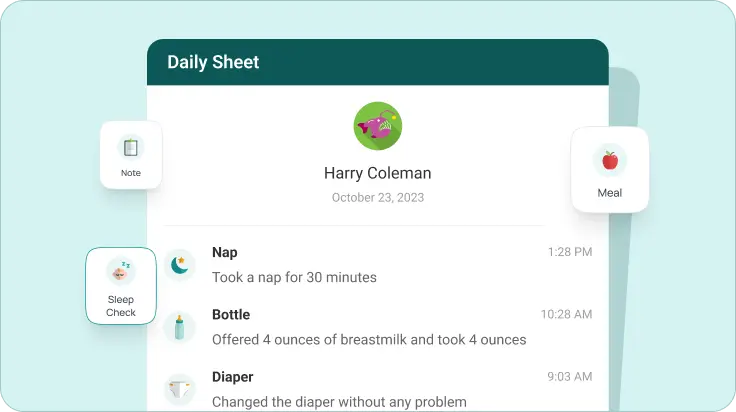
Using a Daily Sheets tool allows early educators to track every aspect of a child's day; from check-in, diaper changes, meals, to check-out. 

This provides a visually appealing way for families to track their children’s progress, and in turn, helps every early childhood program strengthen their partnerships with families with one quick click. 
A Holistic and Individual Approach

Of course, families aren’t simply looking to know how the day went generally, they want to know everything that is going on with their child. 

Families with young children are seeking a more holistic approach to communication to help bridge the gap between home and school. Sure, they want to know what their child has been fed, how long they napped for, and whether their medication was administered, but on top of that, families are now seeking to know even more about how their child spends their day: How is potty training going? What types of activities were they engaged in at Circle Time? Did they make a new friend today?

By using a tool like Kaymbu’s Daily Sheets, families get access to the most up-to-date information–like lesson plans, photos, and videos. This not only helps provide a robust and visually beautiful daily sheet, but enables families to feel more connected to the educational setting itself.


What are Families Really Looking for in a Daily Sheet?

It goes without saying that every family is different, and when it comes to sending daily sheets, it’s important for educators to make sure they are meeting each family’s needs and expectations. For example, every family member doesn’t necessarily need to see every diaper change! Using a tool like Kaymbu can help you maintain relationships with your families, by allowing you to easily customize who receives the daily sheet, and who receives other communication, like newsletters and photos. 

So, what are families really saying they look for in a Daily Sheet? 

  1. Support and Personalized Care

“I love staying up to date on potty training, it’s something that we’re struggling with at home, and seeing the routine at school helps me follow the same schedule at home.”

Children have different care needs. And connecting with families about these needs by sharing specific documentation through a daily sheet can not only help them feel included, but foster positive outcomes for children.  

  1. Learning Moments Matter Too!

“Photos [of my child] are something I love to share with my family and friends. Having an app that allows me to share what’s happening at school with them makes that much easier.” 

Oftentimes, families feel like they miss so much when their child is at school. Finding ways to enable them to share important learning moments with the people they care about helps everyone stay informed, and allows families to celebrate the development of their children!

  1. Conversation Starters

“Knowing the details of [my son's] day is so important to me. As he’s gotten older, we’ve begun to use the information from the daily sheet to spark our dinnertime conversations.”  

There is so much that happens throughout a school day, and so many experiences families want to connect with their children about. By sharing the activities, books, and even meals a child is participating in with families, you are continuing to build strong partnerships and bridge the gap between home and school. 

  1. Consistency

“Consistency is key for me. Knowing that I can expect an update each day really helps me feel connected while I’m not with my daughter. It’s something we’ve begun to rely on.” 

Sending a young child to school can be stressful for families. By creating consistency, you are helping families not only feel connected, but feel secure that their child is being cared for, loved and supported while they’re not together. 

Families want to understand what’s happening while they are apart from their children. They want to know their child was loved and cared for. And they want to know the details their child can’t yet tell them. Sharing digital visually appealing daily sheets, building a holistic picture of the day, and creating a consistent line of communication matters–and early educators are the window into the classroom for families. 

Kaymbu’s mission doesn’t stop at Daily Sheets; we offer an entire suite of applications to ease the heavy and varied workload of early childhood educators! Kaymbu is a robust addition to any early childhood program. Please feel free to contact us with any additional questions.

For Educators, From Educators
Subscribe for practical resources, insights, and stories to support your classroom every month.
Thank you! Your submission has been received!
Oops! Something went wrong while submitting the form.
How to Write a Compelling Daily Sheet
April 6, 2026

The daily sheet helps me feel like I’m a part of my child’s day, even though I’m not physically present. From every diaper change to the blocks he stacks, I appreciate knowing [my child] is loved and cared for the way I would if he were at home.” -- Tanya R.

Early childhood education is increasingly being recognized around the world as a crucial step in a child’s development. As an early educator, you have quite the responsibility—but having the right tools can help you feel empowered. 


Early educators are already juggling so much—from fostering curiosity and engaging in meaningful interactions with children, to ensuring their health and safety—that tracking daily care activities throughout the day to share with families can be overwhelming. Building consistent communication with families is key to child development (not to mention an expectation of many families). Still, it’s all too easy to get bogged down in paperwork.

So, how can you get the support you need while also ensuring that families receive compelling information every day? 

Digitizing your Daily Sheets

Digitizing processes is one of the best ways to save time and effectively connect with families. Picking the right easy-to-use tools can also empower educators to share student information in a compelling way, which leads to better outcomes for children.

Using a Daily Sheets tool allows early educators to track every aspect of a child's day; from check-in, diaper changes, meals, to check-out. 

This provides a visually appealing way for families to track their children’s progress, and in turn, helps every early childhood program strengthen their partnerships with families with one quick click. 

A Holistic and Individual Approach

Of course, families aren’t simply looking to know how the day went generally, they want to know everything that is going on with their child. 

Families with young children are seeking a more holistic approach to communication to help bridge the gap between home and school. Sure, they want to know what their child has been fed, how long they napped for, and whether their medication was administered, but on top of that, families are now seeking to know even more about how their child spends their day: How is potty training going? What types of activities were they engaged in at Circle Time? Did they make a new friend today?

By using a tool like Kaymbu’s Daily Sheets, families get access to the most up-to-date information–like lesson plans, photos, and videos. This not only helps provide a robust and visually beautiful daily sheet, but enables families to feel more connected to the educational setting itself.
What are Families Really Looking for in a Daily Sheet?

It goes without saying that every family is different, and when it comes to sending daily sheets, it’s important for educators to make sure they are meeting each family’s needs and expectations. For example, every family member doesn’t necessarily need to see every diaper change! Using a tool like Kaymbu can help you maintain relationships with your families, by allowing you to easily customize who receives the daily sheet, and who receives other communication, like newsletters and photos. 

So, what are families really saying they look for in a Daily Sheet? 

  1. Support and Personalized Care

“I love staying up to date on potty training, it’s something that we’re struggling with at home, and seeing the routine at school helps me follow the same schedule at home.”

Children have different care needs. And connecting with families about these needs by sharing specific documentation through a daily sheet can not only help them feel included, but foster positive outcomes for children.  

  1. Learning Moments Matter Too!

“Photos [of my child] are something I love to share with my family and friends. Having an app that allows me to share what’s happening at school with them makes that much easier.” 

Oftentimes, families feel like they miss so much when their child is at school. Finding ways to enable them to share important learning moments with the people they care about helps everyone stay informed, and allows families to celebrate the development of their children!

  1. Conversation Starters

“Knowing the details of [my son's] day is so important to me. As he’s gotten older, we’ve begun to use the information from the daily sheet to spark our dinnertime conversations.”  

There is so much that happens throughout a school day, and so many experiences families want to connect with their children about. By sharing the activities, books, and even meals a child is participating in with families, you are continuing to build strong partnerships and bridge the gap between home and school. 

  1. Consistency

“Consistency is key for me. Knowing that I can expect an update each day really helps me feel connected while I’m not with my daughter. It’s something we’ve begun to rely on.” 

Sending a young child to school can be stressful for families. By creating consistency, you are helping families not only feel connected, but feel secure that their child is being cared for, loved and supported while they’re not together. 

Families want to understand what’s happening while they are apart from their children. They want to know their child was loved and cared for. And they want to know the details their child can’t yet tell them. Sharing digital visually appealing daily sheets, building a holistic picture of the day, and creating a consistent line of communication matters–and early educators are the window into the classroom for families. 

Kaymbu’s mission doesn’t stop at Daily Sheets; we offer an entire suite of applications to ease the heavy and varied workload of early childhood educators! Kaymbu is a robust addition to any early childhood program. Please feel free to contact us with any additional questions.

For Educators, From Educators
Subscribe for practical resources, insights, and stories to support your classroom every month.
Thank you! Your submission has been received!
Oops! Something went wrong while submitting the form.
Browse our posts
All
Thank you! Your submission has been received!
Oops! Something went wrong while submitting the form.